How AI on WhatsApp is Transforming Crop Advisory in Indonesia
DayaTani Editorial
October 2025
Artificial Intelligence
Indonesia is home to more than 33 million smallholder farming households, each managing plots that typically range from 0.5 to 2 hectares. For most of these farmers, access to qualified agronomic advice has historically been limited, expensive, or simply unavailable in their local language and dialect. The result is widespread reliance on guesswork, traditional knowledge passed down through generations, or advice from chemical retailers whose primary incentive is to sell inputs.
Artificial intelligence is beginning to change this equation — and the delivery channel making the biggest difference is not a sophisticated mobile app, but the messaging platform already on virtually every farmer's phone: WhatsApp.
Meeting Farmers Where They Are
The core insight behind DayaTani's Farming AI Assistant is deceptively simple: the best agricultural technology is the one farmers will actually use. With WhatsApp penetration exceeding 90% among Indonesian mobile users, the platform represents a near-universal distribution channel that requires zero additional installation, no app store account, and no learning curve.
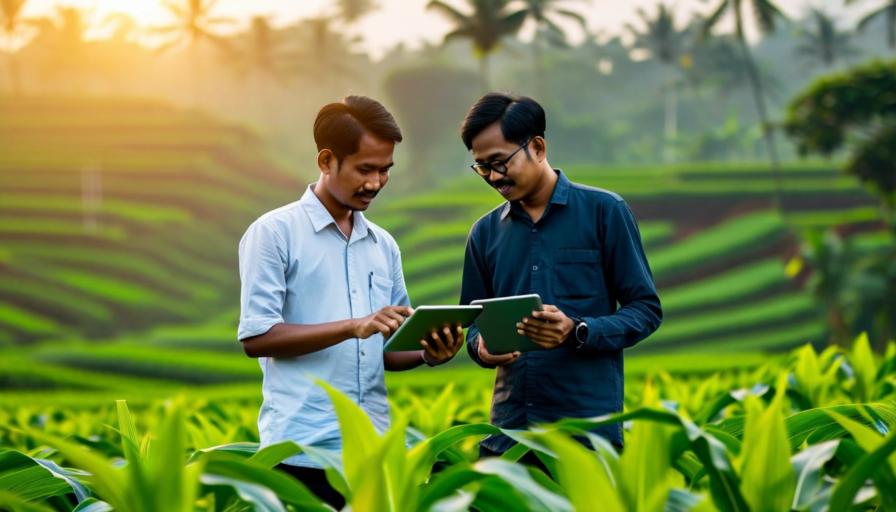
A farmer in Blitar, East Java, can photograph a discoloured leaf on their chilli crop, send it via WhatsApp, and receive a diagnosis within seconds — including a probable cause, recommended treatment, dosage guidance, and a warning about application timing relative to the current weather forecast. The entire interaction takes place in Bahasa Indonesia, and increasingly in regional variants that reflect the linguistic diversity of the archipelago.
What the AI Actually Does
DayaTani's assistant is built on a multi-modal foundation that combines large language model capabilities with computer vision, agronomic knowledge graphs, and real-time data integration. When a farmer submits a query, the system does several things simultaneously:
Image analysis: Computer vision models trained on thousands of labelled crop disease and pest images identify probable causes with confidence scores. For common conditions — blast in rice, late blight in potato, thrips in chilli — accuracy rates exceed 87% in field testing.
Context integration: The system pulls current weather data, historical precipitation patterns, and known pest pressure records for the farmer's sub-district. A diagnosis delivered during a dry period carries different treatment urgency than the same condition during monsoon season.
Knowledge grounding: Responses are grounded in DayaTani's agronomic knowledge base, which is maintained and updated by its team of certified agronomists. This prevents the AI from generating plausible-sounding but agronomically incorrect advice — a critical safeguard when the stakes involve a family's livelihood.
Early Results and Scale
Since the assistant's soft launch across pilot districts in West Java and Central Java, DayaTani has recorded over 45,000 individual farmer interactions. Satisfaction surveys show that 78% of respondents found the advice actionable and relevant to their specific situation — a metric that compares favourably with traditional extension service ratings.
More significantly, farmers who consistently use the advisory system report meaningfully lower chemical input costs. By receiving targeted, condition-specific recommendations rather than calendar-based blanket spraying schedules, participating farmers have reduced fungicide applications by an average of 28% without measurable yield penalties.
The Road Ahead
The next phase of development focuses on proactive advisory — moving from reactive question-answering toward a system that anticipates farmer needs. By integrating satellite-derived vegetation indices, weather forecasts, and historical crop calendars, the assistant will begin pushing timely alerts: a notification that conditions favour early blight development over the coming week, or a reminder that a specific variety's optimal fertilisation window opens in three days.
DayaTani is also piloting voice interaction in Javanese and Sundanese, recognising that text-based interfaces remain a barrier for older farmers or those with limited literacy. The combination of WhatsApp voice notes and AI-powered speech-to-text creates an advisory channel that is both familiar and frictionless.
The broader ambition is to make qualified agronomic advice as accessible as a phone call — and available at any hour, in any weather, across every corner of the archipelago.