IoT Weather Stations Bring Micro-Climate Intelligence to Indonesian Fields
DayaTani Editorial
September 2025
IoT
Agriculture is fundamentally a weather-dependent enterprise. Every decision a farmer makes — when to plant, when to irrigate, when to spray, when to harvest — is shaped by climate conditions. Yet for most Indonesian smallholders, real-time, hyper-local weather data has been entirely out of reach. The nearest official weather station may be dozens of kilometres away, measuring conditions in a valley, on a coast, or at an elevation that bears little resemblance to the micro-climate of a specific hillside plot in Garut or a lowland paddy field in Karawang.
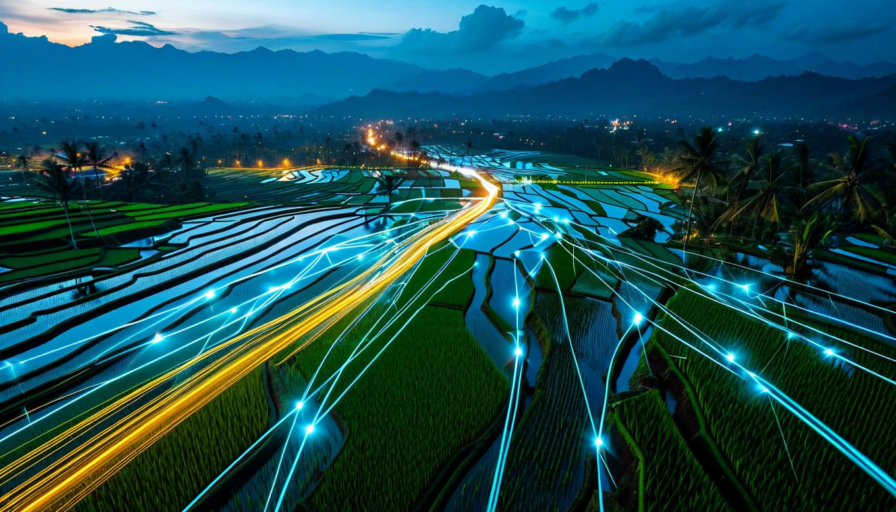
DayaTani's IoT field sensor network is designed to close this gap — placing compact, ruggedised weather stations directly in agricultural zones, collecting granular data that feeds into both immediate alerts and long-term agronomic intelligence.
The Data Gap That Has Always Existed
Indonesia's national meteorological agency BMKG operates approximately 300 automated weather stations across an archipelago of more than 17,000 islands. This translates to one station for roughly every 650,000 hectares of land — a coverage density that is simply insufficient for precision agriculture. Tropical micro-climates, influenced by elevation, proximity to forests, coastal wind patterns and local topography, can vary dramatically over distances of just a few kilometres.
For crops like chilli, coffee, and potato — which are highly sensitive to humidity, temperature fluctuation, and soil moisture — this data gap translates directly into avoidable crop losses. A farmer without access to accurate humidity forecasting may fail to anticipate conditions favourable to Phytophthora infestans, the pathogen responsible for late blight. By the time visible symptoms appear, the infection has already spread beyond the point where fungicide intervention is economically viable.
How the DayaTani Sensor Network Works
DayaTani's weather station units are designed for low-cost deployment in agricultural settings. Each station measures air temperature, relative humidity, solar radiation, wind speed and direction, and rainfall accumulation at 15-minute intervals. A soil probe attachment captures soil temperature and volumetric moisture content at two depths — 10 cm and 30 cm — providing direct insight into root-zone conditions.
Data transmission uses a combination of cellular (4G/LTE) and LoRaWAN depending on connectivity availability in the deployment area. In zones where mobile coverage is limited — common in highland agricultural areas in Sulawesi, West Kalimantan, and parts of East Java — LoRaWAN gateways provide low-power, long-range data uplinks with ranges of up to 15 kilometres in open terrain.
The data flows into DayaTani's cloud platform, where it is processed in real time. Anomaly detection algorithms flag conditions that exceed pre-defined thresholds for specific crops and growth stages — triggering push notifications to the farm management system dashboard and, where enrolled, to the WhatsApp advisory assistant.
Early Warning System in Practice
The early warning capability is the feature with the most immediate economic value. When conditions in a monitored zone enter a disease-risk window — for example, when relative humidity exceeds 85% for more than six consecutive hours at temperatures between 18°C and 24°C, conditions that favour downy mildew in cucurbit crops — the system generates a risk alert that reaches field supervisors and farmers before visible symptoms appear.
In DayaTani's pilot deployment across potato-growing areas in the Dieng Plateau, early warning alerts enabled field teams to apply targeted preventive treatments on affected micro-zones rather than conducting blanket block sprays. Over one growing season, this approach reduced fungicide spend per hectare by 22% while achieving equivalent disease suppression outcomes compared to the previous season's calendar-based approach.
Building a National Agricultural Climate Dataset
Beyond immediate operational value, the sensor network is building something of longer-term strategic significance: a high-density agricultural micro-climate dataset for Indonesia. As deployments scale across more sub-districts and growing seasons, the accumulated data will enable increasingly accurate predictive models that account for local climate patterns not captured in national datasets.
This dataset will underpin the next generation of DayaTani's AI advisory capabilities — crop calendars calibrated to local micro-climate realities, planting date optimisation models, and multi-year risk trend analysis that helps farmers and agribusinesses plan with greater confidence in an era of increasing climate variability.
The convergence of affordable hardware, ubiquitous connectivity, and cloud-native analytics is finally making precision climate intelligence available to farmers who have never had access to it before. That is not a minor incremental improvement — it is a fundamental shift in how agricultural risk is understood and managed across the Indonesian landscape.